
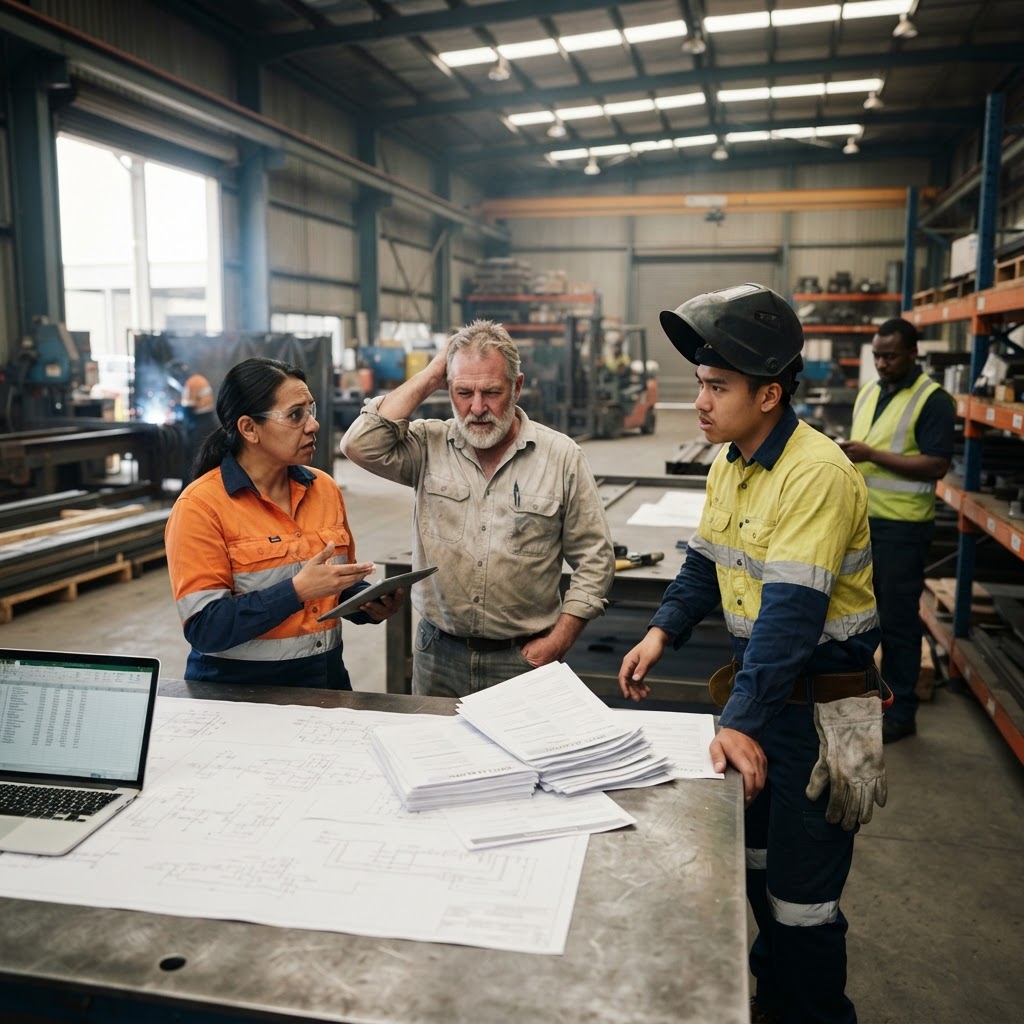
If you manage an industrial site in Australia right now, you are probably familiar with a very specific type of frustration. You post a job ad for a warehouse supervisor, a forklift driver, or a maintenance fitter. The applications roll in. On paper, you have plenty of qualified candidates. Yet, when it comes time to actually put someone on the floor, you are left empty-handed.
This is not just bad luck. It is a documented structural issue in the Australian labour market known as the suitability gap. We are seeing a massive disconnect between the qualifications people hold and the actual capabilities employers need on the ground.
For contingent and blue-collar workforces, this gap is causing major headaches. Sites are left short-staffed, productivity drops, and recruitment costs spiral out of control. But the problem is not necessarily a lack of talent. The problem is how we are looking for it.
Understanding the Suitability Gap
The concept of the suitability gap is not just anecdotal. According to Current skills shortages by Jobs and Skills Australia, suitability gap shortages occur when there are many qualified applicants per vacancy but very few suitable applicants per qualified applicant. This results in critical vacancies remaining unfilled despite a seemingly healthy number of resumes sitting on a hiring manager's desk.
This issue is widespread across the industrial sector. The recent The Hays 2025 Skills Report: Skills-Based Hiring on the Rise in Australia revealed that 85% of hiring managers in Australia and New Zealand report skills gaps within their teams. In the manufacturing sector alone, 52% of employers are feeling the pinch of these pronounced gaps.
So, why are qualified candidates being deemed unsuitable?
The Problem with Job Titles
Historically, the recruitment industry has relied heavily on job titles and formal qualifications to filter candidates. If you need a logistics coordinator, you look for someone who has held the title of logistics coordinator.
However, as noted in As AI recruitment becomes the norm, Australia risks leaving real talent behind by Jobs and Skills Australia, many job platforms only look at job titles and formal qualifications. This approach misses valuable invisible skills that people actually use every day on site. A candidate might have the exact right ticket or degree, but lack the practical problem-solving abilities, safety awareness, or adaptability required for your specific environment.
Moving to a Skills-First Approach
To beat the suitability gap, Australian industrial employers need to stop looking at what a candidate has been called in the past and start looking at what they can actually do. This is where skills-first matching changes the game.
By breaking down a role into its core required skills rather than relying on a generic job title, you open up your talent pool to candidates who have acquired those exact skills in different industries or roles.
Here is why a skills-first approach is critical for blue-collar hiring:
- It uncovers hidden talent: Workers often possess transferable skills that traditional resumes fail to highlight.
- It speeds up time-to-hire: When you match based on verified skills, you spend less time interviewing candidates who look good on paper but cannot perform the tasks.
- It improves retention: Candidates matched to the actual daily realities of a job are far less likely to walk off site in their first week.
According to the Hays data mentioned earlier, 86% of hiring managers are already shifting towards skills-based hiring to mitigate these market gaps. If your site is still relying on outdated CV screening, you are competing for a shrinking pool of traditional candidates while your competitors are tapping into a much broader, more capable workforce.
How Find Your People Bridges the Gap
At Find Your People, we built our platform specifically to solve the suitability gap in the Australian contingent and blue-collar workforce. We know that the traditional recruitment agency model is fragmented, biased, and overly reliant on paper qualifications.
Our marketplace connects employers, recruitment agencies, and candidates through a completely different lens.
De-Identified Profiles and Diversity Tracking
Bias plays a massive role in the suitability gap. Often, capable candidates are screened out unconsciously due to their name, age, or background. Our platform uses de-identified profiles to ensure that hiring decisions are based purely on capability. This not only ensures fair hiring practices but also comes with built-in diversity tracking to help your organisation meet its inclusion goals without compromising on quality.
True Skills-First Matching
We do not just match job titles. Our technology focuses on skills-first matching, aligning the specific, verified capabilities of a worker with the exact requirements of your site. This means when a candidate is shortlisted, you know they have the practical skills to get the job done safely and efficiently.
A Neutral Vendor Marketplace
Managing multiple labour hire agencies is chaotic. Our neutral vendor marketplace model brings all your suppliers into one ecosystem. This creates a single source of truth for your contingent workforce, standardising compliance, rates, and skill verification across the board.
Furthermore, our system ensures exclusive candidate representation. This eliminates the frustrating scenario where three different agencies submit the exact same candidate for your role, saving you time and preventing messy fee disputes.
Stop Filtering and Start Matching
The suitability gap is not going away on its own. As the Australian industrial landscape becomes more complex, the disconnect between paper qualifications and on-site reality will only grow wider.
It is time to stop relying on job titles and start hiring for capability. By embracing a de-identified, skills-first approach, you can finally tap into the talent you need to keep your site moving.
Ready to change how you hire your contingent workforce? Book a demo with Find Your People today and see how our skills-first marketplace can solve your labour shortages.
Sources
* Jobs and Skills Australia, Current skills shortages (n.d.)
* Hays, The Hays 2025 Skills Report: Skills-Based Hiring on the Rise in Australia (2025)